
February 20, 2026
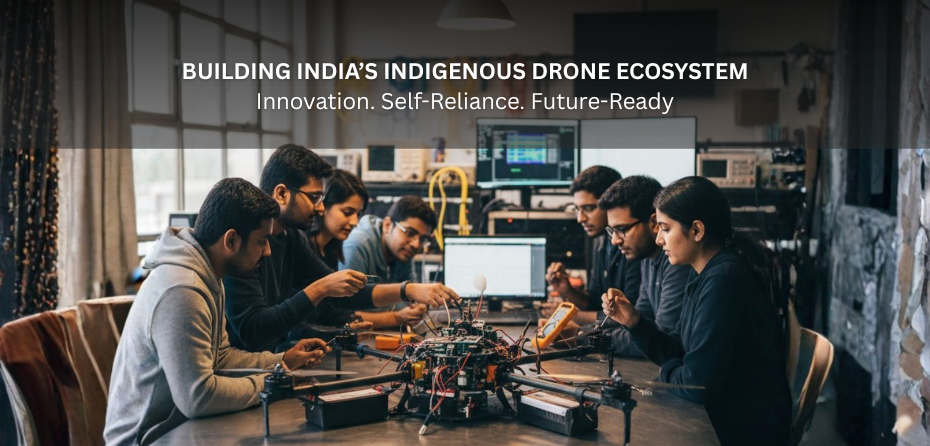
Drones are rapidly becoming a cornerstone of India’s technological and industrial future. From precision agriculture and medical deliveries to disaster response and infrastructure mapping, drone technology is reshaping how essential services are delivered. What once felt futuristic is now a practical and scalable reality.
The iCreate Drone Challenge (iDC) is strengthening India’s drone ecosystem by promoting indigenous drone technology and enabling innovation across regions.
India’s dependence on imported drone components exposes the ecosystem to risks such as supply chain disruptions, cost volatility, and technology access limitations. Indigenous drone development is therefore not optional; it is critical for long-term resilience and national capability.
Home-grown technologies allow solutions to be tailored to India’s terrain, climate, and operational needs. They also strengthen data security, improve affordability, and ensure technological sovereignty. Beyond technology, indigenous drone manufacturing stimulates local industry, advances deep-tech research and development, and creates high-skilled employment opportunities across the value chain.
Government initiatives such as the Production Linked Incentive (PLI) scheme and the Atmanirbhar Bharat mission have created strong momentum for domestic drone innovation. However, sustained progress depends on entrepreneurs, engineers, and innovators who can translate ideas into deployable technologies.
It is within this context that the iCreate Drone Challenge (iDC) plays a pivotal role. The programme is not limited to training participants in drone operations; it is designed to build future-ready indigenous drone technologies through structured learning, hands-on experimentation, and product-focused innovation.
Through iDC, iCreate has created a national platform that brings together startups, academic institutions, industry experts, and mentors to accelerate the development of indigenous subsystems such as propellers, airframes, flight controllers, navigation systems, and payload technologies.
A distinctive feature of the programme has been the emergence of innovation from Tier-2 and Tier-3 cities. Centres such as Vadodara (Gujarat), Pathanamthitta (Kerala), Jhajjar (Haryana), Raiganj (West Bengal), and Purandar (Maharashtra)have demonstrated remarkable progress, highlighting the depth and diversity of India’s engineering talent beyond metropolitan hubs. These micro-innovation clusters are now contributing meaningfully to India’s indigenisation efforts.
Women innovators are playing an increasingly important role in shaping India’s drone ecosystem. It’s encouraging to see more women actively contributing to this evolving deep-tech landscape and driving meaningful innovation across the sector.
One such example is Muskan from Stelx Dynamics, who is developing GPS-denied autonomous drone systems focused on improving reliability and operational resilience.
Another notable innovator is Varshini Ram from Azper Science, who is building a triple-redundant, AI-enabled autopilot platform designed to deliver autonomous navigation and mission-critical reliability for unmanned vehicles operating in defence and high-risk industrial environments. This inclusive approach strengthens not only the technology landscape but also the diversity and depth of India’s innovation community.
The programme also witnessed a powerful transformation, with selected innovators advancing their TRL levels from 1–2 to 3 and 4, evolving from early-stage concepts to functional prototypes with validated system performance. This progress reflects iCreate’s structured approach to nurturing bold ideas and accelerating them from ideation to pilot-ready solutions, empowering innovators to move closer to real-world deployment and scalable impact.
With regulatory frameworks maturing and government incentives accelerating adoption, advanced aerial technologies such as eVTOL platforms and swarm drone systems are expected to reshape logistics, defence preparedness, precision agriculture, and urban air mobility over the next decade.
iCreate remains committed to strengthening India’s indigenous drone ecosystem through structured learning programmes, prototyping support, and sustained mentorship. India’s drone future is not only about reaching new heights, but it is also about building long-term technological capability and ownership of core technologies. That future is being shaped today.


